 686
686

 技術社區[雲棲]
設計自己的MVC框架
取這樣一個標題太大,吸引眼球嘛@_@。
事實是最近讀《J2EE設計模式》講述表達層模式的那幾章,書中有一個前端控製器+command模式的workflow例子,就琢磨著可以很簡單地擴展成一個MVC框架。花了一個下午改寫了下,對書中所述的理解更為深入。我想這也許對於學習和理解設計模式,以及初次接觸struts等MVC框架的人可能有點幫助。因為整個模型類似於struts,我把它取名叫strutslet^_^
(一)完整的類圖如下:
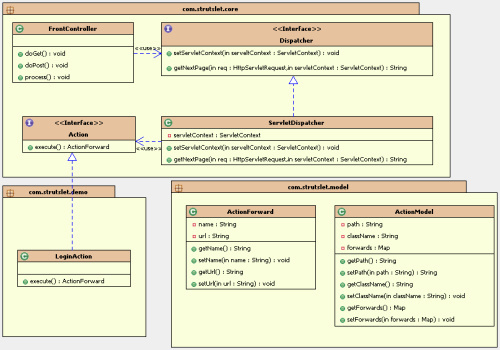
1。前端控製器(FrontController):前端控製器提供了一個統一的位置來封裝公共請求處理,它的任務相當簡單,執行公共的任務,然後把請求轉交給相應的控製器。在strutslet中,前端控製器主要作用也在於此,它初始化並解析配置文件,接受每個請求,並簡單地把請求委托給調度器(Dispatcher),由調度器執行相應的動作(Action)。調度器把action返回的url返回給FrontController, FrontController負責轉發。
2。Action接口:command模式很好的例子,它是一個命令接口,每一個實現了此接口的action都封裝了某一個請求:新增一條數據記錄並更新model,或者把某個文件寫入磁盤。命令解耦了發送者和接受者之間聯係。發送者調用一個操作,接受者接受請求執行相應的動作,因為使用Command模式解耦,發送者無需知道接受者任何接口。
3。Dispatcher:調度器,負責流程的轉發,負責調用action去執行業務邏輯。由調度器選擇頁麵和action,它去除了應用行為和前端控製器間的耦合。調度器服務於前端控製器,它把model的更新委托給action,又提供頁麵選擇給FrontController
4。ActionForward:封裝了轉向操作所需要信息的一個模型,包括name和轉向url
5。ActionModel:解析配置文件後,將每一個Action封裝成一個ActionModel對象,所有ActionModel構成一個map,並存儲在ServletContext中,供整個框架使用。
(二)源代碼分析:
1。Action接口,隻有一個execute方法,任何一個action都隻要實現此接口,並實現相應的業務邏輯,最後返回一個ActionForward,提供給Dispacher調用。
 package com.strutslet.core; import javax.servlet.ServletContext; import javax.servlet.http.HttpServletRequest; import com.strutslet.model.ActionForward;
 /**
/**  * command接口 * @author dennis *
 */ public interface Action { public ActionForward execute(HttpServletRequest request,ServletContext context); }
比如,我們要實現一個登陸係統,LoginAction驗證用戶名和密碼,如果正確,返回success頁麵,如果登陸失敗,返回fail頁麵:
package com.strutslet.demo; import javax.servlet.ServletContext; import javax.servlet.http.HttpServletRequest; import com.strutslet.core.Action; import com.strutslet.model.ActionForward; public class LoginAction implements Action { private String name = "" ; public ActionForward execute(HttpServletRequest request, ServletContext context) { String userName = request.getParameter( " userName " ); String password = request.getParameter( " password " ); if (userName.equals( " dennis " ) && password.equals( " 123 " )) { request.setAttribute( " name " , name); return ActionForward.SUCCESS; // 登陸成功,返回success
  } else return ActionForward.FAIL; // 否則,返回fail } }
2。還是先來看下兩個模型:ActionForward和ActionModel,沒什麼東西,屬性以及相應的getter,setter方法:
package com.strutslet.model; /** * 類說明:轉向模型 * @author dennis * * */ public class ActionForward { private String name; // forward的name private String viewUrl; // forward的url public static final ActionForward SUCCESS = new ActionForward( " success " ); public static final ActionForward FAIL = new ActionForward( " fail " ); public ActionForward(String name) { this .name = name; } public ActionForward(String name, String viewUrl) { super (); this .name = name; this .viewUrl = viewUrl; } //  name和viewUrl的getter和setter方法 } 我們看到ActionForward預先封裝了SUCCESS和FAIL對象。 // ActionModel.java package com.strutslet.model; import java.util.Map; /** * 類說明: * @author dennis * */ public class ActionModel { private String path; // action的path private String className; // action的class private Map < String, ActionForward > forwards; // action的forward public ActionModel() {} public ActionModel(String path, String className, Map < String, ActionForward > forwards) { super (); this .path = path; this .className = className; this .forwards = forwards; } // 相應的getter和setter方法 }
3。知道了兩個模型是什麼樣,也應該可以猜到我們的配置文件大概是什麼樣的了,與struts的配置文件格式類似:
<? xml version = " 1.0 " encoding = " UTF-8 " ?> < actions > < action path = " /login " class = " com.strutslet.demo.LoginAction " > < forward name = " success " url = " hello.jsp " /> < forward name = " fail " url = " fail.jsp " /> </ action > </ actions >
path是在應用中將被調用的路徑,class指定了調用的哪個action,forward元素指定了轉向,比如我們這裏如果是success就轉向hello.jsp,失敗的話轉向fail.jsp,這裏配置了demo用到的LoginAction。
4。Dispacher接口,主要是getNextPage方法,此方法負責獲得下一個頁麵將導向哪裏,提供給前端控製器轉發。
package com.strutslet.core; import javax.servlet.ServletContext; import javax.servlet.http.HttpServletRequest; /** * service to worker模式,提供給FrontController使用 * 負責流程轉發 * @author dennis * */ public interface Dispatcher { public void setServletContext(ServletContext context); public String getNextPage(HttpServletRequest request,ServletContext context);}
5。原先書中實現了一個WorkFlow的Dispatcher,按照順序調用action,實現工作流調用。而我們所需要的是根據請求的path 調用相應的action,執行action的execute方法返回一個ActionForward,然後得到ActionForward的 viewUrl,將此viewUrl提供給前端控製器轉發,看看它的getNextPage方法:
public String getNextPage(HttpServletRequest request, ServletContext context) { setServletContext(context); Map < String, ActionModel > actions = (Map < String, ActionModel > ) context .getAttribute(Constant.ACTIONS_ATTR); // 從ServletContext得到所有action信息 String reqPath = (String) request.getAttribute(Constant.REQUEST_ATTR); // 發起請求的path ActionModel actionModel = actions.get(reqPath); // 根據path得到相應的action String forward_name = "" ; ActionForward actionForward; try { Class c = Class.forName(actionModel.getClassName()); // 每個請求對應一個action實例 Action action = (Action) c.newInstance(); actionForward = action.execute(request, context); // 執行action的execute方法 forward_name = actionForward.getName(); } catch (Exception e) { log.error( " can not find action " + actionModel.getClassName()); e.printStackTrace(); } actionForward = actionModel.getForwards().get(forward_name); if (actionForward == null ) { log.error( " can not find page for forward " + forward_name); return null ; } else return actionForward.getViewUrl(); // 返回ActionForward的viewUrl }
6。前端控製器(FrontController),它的任務我們已經很清楚,初始化配置文件;存儲所有action到 ServletContext供整個框架使用;得到發起請求的path,提供給Dispachter查找相應的action;調用Dispatcher,執行getNextPage方法得到下一個頁麵的url並轉發:
public void init() throws ServletException { // 初始化配置文件 ServletContext context = getServletContext(); String config_file = getServletConfig().getInitParameter( " config " ); String dispatcher_name = getServletConfig().getInitParameter( " dispatcher " ); if (config_file == null || config_file.equals( "" )) config_file = " /WEB-INF/strutslet-config.xml " ; // 默認是/WEB-INF/下麵的strutslet-config if (dispatcher_name == null || dispatcher_name.equals( "" )) dispatcher_name = Constant.DEFAULT_DISPATCHER; try { Map < String, ActionModel > resources = ConfigUtil.newInstance() // 工具類解析配置文件 .parse(config_file, context); context.setAttribute(Constant.ACTIONS_ATTR, resources); // 存儲在ServletContext中 log.info( " 初始化strutslet配置文件成功 " ); } catch (Exception e) { log.error( " 初始化strutslet配置文件失敗 " ); e.printStackTrace(); } // 實例化Dispacher try { Class c = Class.forName(dispatcher_name); Dispatcher dispatcher = (Dispatcher) c.newInstance(); context.setAttribute(Constant.DISPATCHER_ATTR, dispatcher); // 放在ServletContext log.info( " 初始化Dispatcher成功 " ); } catch (Exception e) { log.error( " 初始化Dispatcher失敗 " ); e.printStackTrace(); } ..
doGet()和doPost方法我們都讓它調用process方法:
protected void process(HttpServletRequest request, HttpServletResponse response) throws ServletException, IOException { ServletContext context = getServletContext(); // 獲取action的path String reqURI = request.getRequestURI(); int i = reqURI.lastIndexOf( " . " ); String contextPath = request.getContextPath(); String path = reqURI.substring(contextPath.length(),i); request.setAttribute(Constant.REQUEST_ATTR, path); Dispatcher dispatcher = (Dispatcher) context.getAttribute(Constant.DISPATCHER_ATTR); // make sure we don't cache dynamic data response.setHeader( " Cache-Control " , " no-cache " ); response.setHeader( " Pragma " , " no-cache " ); // use the dispatcher to find the next page String nextPage = dispatcher.getNextPage(request, context); // 調用Dispatcher的getNextPage // forward control to the view RequestDispatcher forwarder = request.getRequestDispatcher( " / " + nextPage); forwarder.forward(request, response); // 轉發頁麵 }
7。最後,web.xml的配置就非常簡單了,配置前端控製器,提供啟動參數(配置文件所在位置,為空就查找/WEB-INF/下麵的strutslet-config.xml文件),我們把所有以action結尾的請求都交給FrontController處理:
< servlet > < servlet - name > StrutsletController </ servlet - name > < servlet - class > com.strutslet.core.FrontController </ servlet - class > <!-- < init - param > < param - name > config </ param - name > < param - value >/ WEB - INF / strutslet - config.xml </ param - value > </ init - param > --> < load - on - startup > 0 </ load - on - startup > </ servlet > < servlet - mapping > < servlet - name > StrutsletController </ servlet - name > < url - pattern >* .action </ url - pattern > </ servlet - mapping >最後更新:2017-05-17 00:48:09